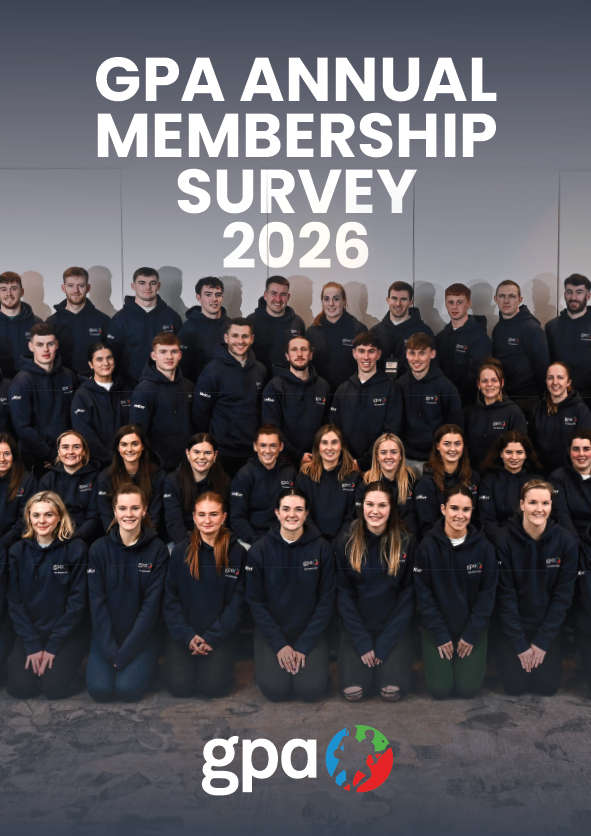
85% of inter-county players back sharing performance data for welfare as injuries remain high
Survey also finds little appetite for major rule changes, off-season remains a challenge, positive county team experiences and majority support for equalising the Squad Charter.
The full report can be read HERE.
Inter-county players want their performance data used more effectively to support workload, welfare and injury risk, according to the Gaelic Players Association’s 2026 Annual Member Survey. Among 3,555 respondents across the four codes, 85% support sharing their data with a centralised database for those purposes.
Players also want a say in how their data is used; 80% support a meaningful role, while some 82% support commercial use of performance data where players receive a fair share of revenue. Yet 39% do not know whether their data has been shared or used beyond their team. The GPA says players must have a meaningful say in how any wider use of their data is governed.
The survey highlights four further findings:
- Injuries remain high: 74% of respondents reported an injury (in line with 2025) and 49% of players had two weeks or less rest between the end of club and start of inter-county,
- No major appetite for rule changes: 76% of male footballers want no further rule change and 23.5% want only small tweaks. In hurling, seven substitutions, two-point sidelines and the Maor Foirne were the only surveyed changes with majority support,
- Male players recognised positive county team environments in the new Team Scorecard ratings, averaging a score of 4.4 out of 6
- Among male players, 72% reported receiving their full Squad Charter entitlements, while 18% were unsure. Female players report gaps in some supports and difficulties with the timing of expenses; 94% support moving to monthly expenses in 2027. 78% of players support one minimum standards Charter for all players; just 1% opposed.
Season structure and injury
The short breaks between club and county competition continue to affect players’ opportunity to recover. The share of female players with no more than two weeks between the end of their club season and the start of inter-county activity rose sharply compared with 2025 (47% v 38%). Injury prevalence has remained broadly steady on 2025 figures despite the debate about season structure: 74% reported missing a training / game through injury this year, 45% of injured players were out for at least four weeks. Among players reporting injury types, Hamstring remains by far the most common injury among males at 27%, while lower leg injuries dominate for females (20%) with a notable gender difference in ACL injuries persists (5% f v 3% m).
In open-ended feedback, players sought more consistent spacing between games, fewer competition clashes and sufficient recovery, rather than simply a shorter season.
Playing rules
In men’s football, just 0.5% of surveyed players called for significant further rule changes, and 23.5% support small tweaks Of those who suggested a change, handing the ball back after a foul was the most commonly cited issue; one recurring suggestion was to allow the player to place the ball on the ground at the point of the foul. Some 73% of male players support increased use of technology, but the majority only want it to be limited and targeted, rather than a full video review system.
County Teams & Squad Charters
For the first time, male players completed a Team Scorecard ranking their Inter-county experience across a number of areas, which delivered an average overall experience rating of 4.4 out of 6. Limerick hurling recorded the highest individual team score, followed by Mayo and Kerry football. Several lower-tier teams also scored strongly. The results recognise the importance of the Squad Charter in prompting good experiences and the highlight the work of county boards, management teams and backroom staff.
The Squad Charter provides a strong base of support, while the survey identifies differences in delivery. Female players reported strong core match-day supports, with gaps in some training and specialist provision, especially at lower tiers. Seven in ten female players reported at least one significant issue with the current two-instalment expenses system, and 94% support monthly reimbursement in 2027. 78% of all players support one minimum standards Squad Charter following integration, rising to 99% when neutral/don’t know responses are excluded.
Speaking about the publication of the findings, GPA CEO Tom Parsons said:
“One of the most encouraging things in this survey is that players are not resistant to innovation. They see real value in their data being used to support welfare and help us better understand workload and injury, but they also want transparency and a proper say in how their data is used.
“The findings on the rules are also useful at a time when changes are being reviewed and trialled. The message from players is that minimal change is needed. In both football and hurling, the preference is for small, practical improvements.
“It is equally important to recognise what works well. The Team Scorecards show that players are having positive experiences in a lot of county environments. There is significant work and investment in inter-county players, and there is plenty of good practice that can be shared.
“At the same time, player welfare must remain at the centre of the conversation. Injury levels remain high and too many players are still moving from one season into another with very little recovery. Better use of player data can be part of how we understand and address that.
“The Charter findings tell a similar story. There is a strong base of support in place, but we know there is more to do, particularly on how expenses are administered for our female players who are only paid in 2 instalments, compared to male players who are paid monthly. Every player, regardless of code or county, should expect the same minimum standard.”
The full report can be read HERE.